
How do I correctly reconstitute a peptide vial?
Updated: 2026-09-09 · Reconstitution and syringes
Short answer
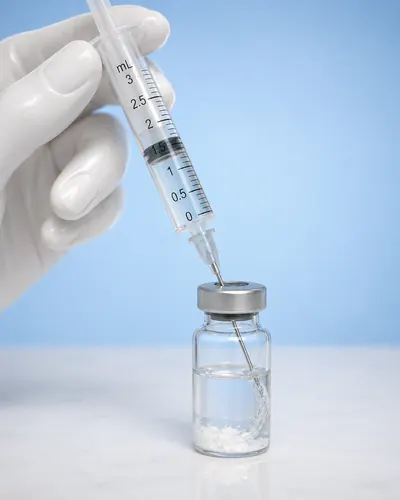
Reconstituting means adding the sterile diluent that the product specifies to a lyophilized product. Which diluent, what volume, how it is handled, how it is stored and how long it can be used afterwards are product-specific facts. Where an approved label or a pharmacist or clinician instruction exists, that specific instruction is the one to follow; there is no general technique valid for every peptide.
In plain English
- Start from the product's own instructions: diluent, volume and handling differ between manufacturers.
- The volume you add sets the final concentration in mg per ml — that is arithmetic, not a recommendation.
- The in-use period after reconstitution and the storage conditions are also product-specific.
- This page gives no step-by-step technique, because one technique does not fit every product.
What we know
- Bacteriostatic water is a multi-dose diluent containing benzyl alcohol, which is why it tolerates repeated withdrawals in products where that diluent is indicated. It is not the right diluent for everything.
- Vigorous agitation can affect the stability of some protein and peptide formulations, but the magnitude and the handling instructions are formulation-specific.
What we don't know yet
- There is no scientifically 'ideal' volume — it is a practical concentration decision.
How much and how often is a clinical decision. This page explains concepts, not a preparation protocol.
Sources
External links to official sources or peer-reviewed studies.